SIMETRI will showcase its Multi Modal Medical Training System (M3TS) at the Army Simulation and Training Technology Center’s booth during the Interservice/Industry Training, Simulation and Education Conference (I/ITSEC), in Orlando, Florida, Dec. 2-5.
The mobile version of SIMETRI’s M3TS (pronounced “mets”) features an immersive, care-under-fire scenario. The components of this mobile version include billboards that will provide a blue screen chroma key, a mixed reality headset, speakers for immersive, 3D audio, an air rifle version of the M4 carbine, and haptic technology (not be confused with haptic gloves).
“We want people to touch and feel real things,” said Darin Hughes, Ph.D., SIMETRI’s lead software engineer. “Our scenario involves a physical manikin that has lost a limb, and participants put a tourniquet on it. We want people doing that with their actual hands for a realistic training experience, as well as moving a physical manikin.”
Hughes emphasized that M3TS requires trainees to make decisions throughout the scenario that involve going back and forth from providing care to a physical manikin, to returning fire against a virtual enemy, as circumstances evolve.
M3TS sets itself apart with the hands-on experience it provides to trainees through their interactions with the system based with the physical world, whether they are shooting a rifle or tightening a tourniquet.
“It’s a big advantage, because you’re actually going through the motions you’d go through in real life due to the mixed reality applications that M3TS provides – which a lot of purely virtual simulations fail to do,” Hughes said. “Haptic gloves can potentially even lead to negative training because certain virtual actions just don’t feel like they do in real life.”
Hughes said M3TS also improves warfighter readiness by helping soldiers psychologically prepare, not only for traditional combat scenarios, but other situations they might not expect, particularly in a gender-integrated military.
“The M3TS manikin is a female manikin that has breasts [and other gender-specific characteristics],” Hughes said. “Research has indicated that men, and even some women, are much more hesitant to do full body searches for entry wounds and exit wounds when it comes to areas like the breasts. That is another area we train and evaluate [in addition to] hasty tourniquet application and other decision-making processes for care under fire.”
A significant feature of M3TS includes its ability to store and track data, according to Hughes. It can tell how many times trainees have fired at the enemy, if trainees have been shot, and how long it took them to go from engaging the enemy to tending to the casualty. The tourniquets also send pressure data, and they can be applied to live “patients” without discomfort due to a built-in spring system. Evaluators can pull these objective data points and provide them to anyone training on M3TS. The newest iteration of the system can share data with third-party simulations and can hand off data to other scenarios involving expanded care or medevac procedures.
Hughes said that M3TS began as a Small Business Innovation Research (SBIR) phase I project that was “pretty limited in scope.” Since it entered phase II, SIMETRI has improved the mixed reality images and field of view in its headsets with a video pass-through, head-mounted display, which uses cameras to blend virtual images that a trainee sees simultaneously with the real world. Such refinements provide for a more immersive environment, and make it possible to use the processing power of modern gaming computers.
“M3TS went from presenting one bad guy and a virtual building with a toy rifle, to a fully immersive market scene in a deployed setting with an overturned Humvee, virtual soldiers that fight with you, and enemies that can appear from different locations and respawn,” Hughes said. “We’ve done a ton of work with our wireless communications, which have gone from basic Wi-Fi to Bluetooth Low Energy, which is more reliable and uses far less battery power, so a simulation can be run over and over without changing out batteries to recharge them. M3TS is almost unrecognizable from phase I to phase II.”
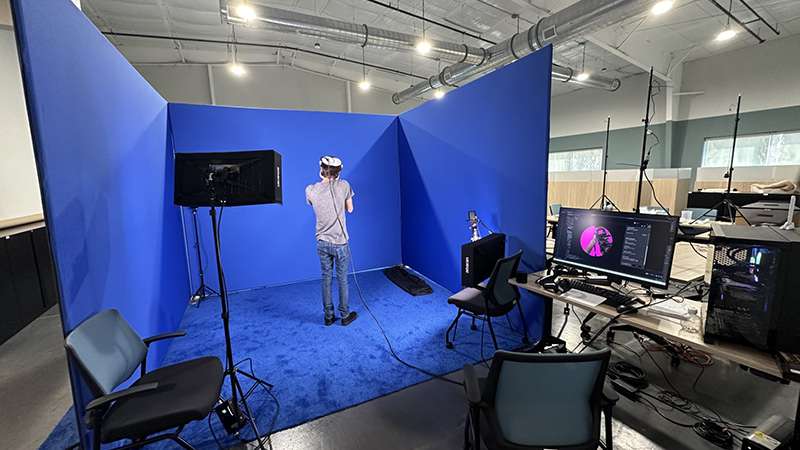
The more stationary version of M3TS located at SIMETRI’s office, includes a 20-by-20-foot blue screen chroma key set, a surround sound audio system, and haptic transducers beneath the floor to provide vibrations from simulated explosions, tracking cameras, and a mixed reality headset to provide a high-fidelity training environment.
“We’ve consistently received positive responses when demonstrating M3TS in public settings due to its immersive aspects and delivery of realistic training,” said Angela Alban, founder and CEO of SIMETRI. “M3TS recently began its SBIR phase II sequential stage, and this development tells us that the Defense Department and the warfighters who use M3TS consider it a valuable training asset to prepare them for worst-case scenarios. We’re really looking forward to showing the improvements we’ve made to M3TS at I/ITSEC this year.”